Expert Articles for Smarter Car Care
Luxury Car Accident Repair in Petaling Jaya: What Should Be Inspected Beyond Visible Body Damage?
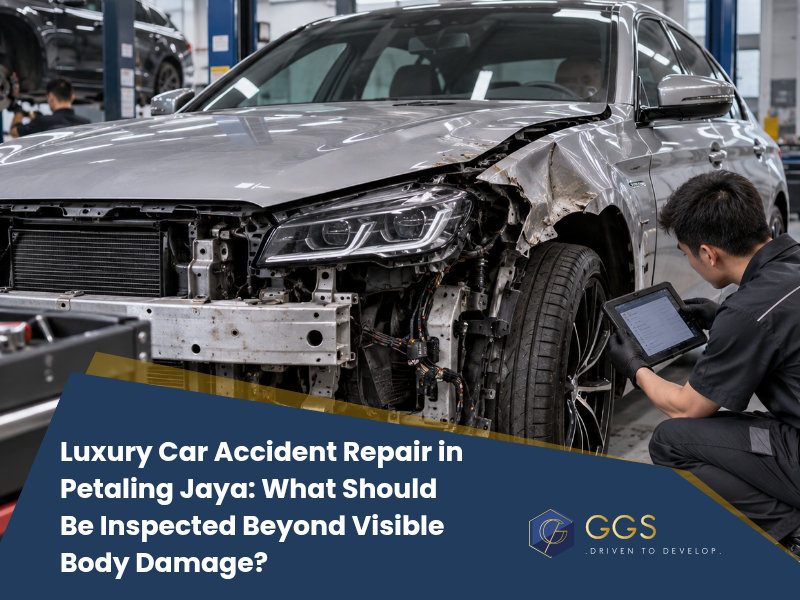
Table of Contents
A damaged bumper, fender or door tells a workshop where the collision occurred, but not necessarily where the damage stopped.
Impact force can travel beyond the visible panel and affect reinforcement structures, mounting points, suspension components, cooling hardware, wiring, sensors and electronic systems. On a modern luxury vehicle, this matters even more because many mechanical and electronic components are packed tightly around common impact zones.
That is why proper luxury car accident repair in Petaling Jaya should begin with a structured post-collision inspection, not just an assessment of dents, scratches and paint damage.
Visible Damage Does Not Always Show Where the Impact Stopped
Modern vehicles are designed with multiple structural layers, reinforcements, brackets and mounting points beneath the exterior body panels.
A bumper cover may look only lightly damaged while components behind it have shifted. A wheel may appear intact while the impact has travelled through the hub, steering knuckle, control arm or subframe.
For a workshop, the key question is not only:
What can be seen?
It is also:
Where could the impact force have travelled?
This changes the inspection from a cosmetic assessment into a technical damage evaluation.
Start With the Direction and Path of the Collision
The direction of impact can guide the workshop toward the systems most likely to have been affected.
Front-End Impact
A frontal collision may involve:
- bumper reinforcement;
- crash structures;
- radiator supports;
- condenser and radiator;
- cooling fans;
- intercoolers or other coolers;
- headlights;
- sensors;
- wiring and connectors.
Wheel or Kerb Impact
An impact around the wheel may transfer force through:
tyre → wheel → hub → steering knuckle → control arm → subframe → body mounting point
Even when the body panel damage is minor, the suspension geometry may have changed.
Side or Rear Impact
A side or rear collision may affect:
- door structure;
- sill areas;
- pillars;
- rear reinforcement;
- boot floor;
- parking sensors;
- lighting wiring;
- restraint-system components.
Understanding the impact path helps the workshop decide what needs deeper inspection before the repair scope is confirmed.
Inspect Structural Members and Mounting Points
Hidden structural damage does not always mean an obviously bent chassis rail.
Sometimes the more important problem is a smaller change in a mounting area, bracket or attachment point.
A workshop may need to inspect:
- crash reinforcements;
- crossmembers;
- structural rails;
- welded brackets;
- subframe mounting points;
- bumper mounting points;
- suspension mounting locations;
- panel attachment points.
Damage may appear as:
- distortion;
- cracked brackets;
- displaced mounting holes;
- damaged welds;
- stretched metal;
- altered panel gaps.
A small movement at a mounting point can affect several systems at once. It may change panel alignment, suspension geometry or the position of a sensor bracket.
Where visual inspection is not enough, appropriate structural measurement may be needed to confirm whether reference points remain within specification.
Suspension and Steering Damage May Be Hidden
Collision-related suspension damage should not be confused with normal wear.
After a wheel or side impact, the workshop may need to inspect:
- control arms;
- tie rods;
- steering knuckles;
- hubs and wheel bearings;
- bushings;
- struts or shock absorbers;
- subframes;
- steering rack mounting points.
Possible symptoms after an accident include:
- steering wheel no longer centred;
- vehicle pulling to one side;
- vibration;
- unusual suspension noise;
- different ride height;
- abnormal tyre wear.
Wheel alignment can provide useful evidence, but it should not be used to compensate for a bent or displaced component.
If alignment readings are abnormal, the underlying cause should be identified first.
Check the Cooling Package After Front-End Damage
The cooling package is one of the most easily overlooked areas after a front-end collision.
Behind the bumper and grille may sit several components close together, including:
- air-conditioning condenser;
- radiator;
- cooling fans;
- fan shroud;
- intercooler;
- oil cooler;
- transmission cooler;
- coolant hoses;
- mounting brackets.
A bumper cover may partly return to shape after impact while a radiator support, condenser or fan assembly behind it remains bent or cracked.
The workshop should therefore look for more than obvious fluid leakage.
Possible hidden signs include:
- bent cooling fins;
- cracked mounting tabs;
- displaced fan assemblies;
- damaged hoses;
- restricted airflow;
- fan contact;
- slow coolant loss;
- refrigerant leakage.
Some cooling-system problems may only appear later through overheating, weak air-conditioning performance or abnormal fan noise.
Wiring, Sensors and Electronic Systems Need Their Own Inspection
Luxury vehicles often have more electronic hardware positioned around the bumper, wheel arch, windscreen and body structure.
Depending on the vehicle, the workshop may need to inspect:
- parking sensors;
- radar sensors;
- cameras;
- wheel-speed sensors;
- ride-height sensors;
- lighting modules;
- wiring harnesses;
- electrical connectors.
One important point is that a sensor can be electrically functional but still be positioned incorrectly.
For example, a sensor bracket may bend or a mounting surface may move during an accident. The sensor may still communicate with the vehicle, but its physical position may no longer be correct.
The workshop should therefore consider:
sensor condition + bracket condition + mounting position + wiring condition
rather than checking the sensor alone.
Wiring should also be inspected for:
- stretched harnesses;
- crushed wires;
- broken connector locks;
- damaged grounds;
- moisture intrusion;
- intermittent connections.
Diagnostic Scanning Is Not the Same as Diagnosis
A diagnostic scan is useful after a collision, but it should not be treated as the diagnosis itself.
A pre-repair scan may identify:
- stored diagnostic trouble codes;
- communication faults;
- sensor faults;
- restraint-system faults;
- voltage-related faults;
- module errors.
However, a fault code only shows what the system has detected.
It does not automatically prove which component has failed.
The workshop may still need to inspect:
- wiring;
- connectors;
- brackets;
- sensor position;
- physical impact damage;
- related components.
The diagnostic process should therefore follow:
fault code → affected system → physical inspection → repair → post-repair confirmation
Restraint Systems May Also Need Attention
Collisions can affect safety systems even when the visible body damage appears limited.
Depending on the impact, relevant components may include:
- airbags;
- seat-belt pretensioners;
- impact sensors;
- restraint-system wiring;
- restraint control modules.
A vehicle may also store restraint-related fault information even if the airbags did not deploy.
Where these systems are involved, inspection and repair should follow the appropriate vehicle-specific procedure.
Controlled Disassembly May Reveal the Actual Damage
Some accident damage cannot be confirmed until damaged exterior components are removed.
A workshop may need to remove:
- bumper covers;
- lamps;
- wheel-arch liners;
- undertrays;
- trims;
- damaged body panels.
This may reveal:
- broken brackets;
- hidden cracks;
- bent reinforcement;
- damaged wiring;
- displaced mounting points;
- concealed fluid leaks.
That is why the initial estimate and confirmed repair scope are not always the same.
A preliminary assessment is based on what can be seen.
The confirmed scope is based on what is found after the affected area has been properly inspected.
Inspect the Undercarriage Where the Impact Suggests It
Not every accident affects only the body.
A vehicle that has struck a kerb, road divider, debris or another object may also have damage underneath.
Relevant areas can include:
- underbody panels;
- subframes;
- suspension mounting points;
- exhaust components;
- fluid lines;
- undertrays.
This is particularly important where the accident involved a wheel strike or underbody impact.
Confirm the Repair Scope Before Final Refinishing
Body and paint repair should come after the workshop understands the technical condition of the affected area.
Before final refinishing, the workshop should confirm that relevant:
- structural points;
- suspension components;
- cooling hardware;
- wiring;
- sensors;
- panel alignment
have been inspected and repaired where necessary.
This helps reduce the risk of completing high-quality paintwork only to discover later that a mechanical or electronic problem still requires access to the same area.
A good finish is important, but appearance alone does not prove that the collision repair is complete.
Post-Repair Verification Is Part of the Repair
The final stage should confirm that the vehicle works correctly as well as looks correct.
Depending on the damage, this may include:
- checking panel fit;
- confirming structural measurements;
- verifying wheel alignment;
- inspecting for fluid leaks;
- checking steering behaviour;
- confirming suspension operation;
- performing a post-repair scan;
- checking sensor operation;
- carrying out calibration where required;
- road testing where appropriate.
Calibration requirements depend on vehicle design and the repair performed. A sensor or camera should only be calibrated where the relevant repair procedure requires it.
A professional post-collision process should therefore follow:
initial assessment → impact-path inspection → diagnostic scan → controlled disassembly → structural, mechanical and electronic inspection → confirmed repair scope → repair → alignment or calibration where required → post-repair scan → final quality control
Owners should look for this broader repair approach when evaluating accident-repair capability.
[Internal link suggestion: Link to “How to Choose a Luxury Car Workshop: A Workshop Owner’s 10-Point Checklist” using anchor text “choosing a luxury car workshop”]
Frequently Asked Questions
1. Can a minor accident cause hidden damage?
Yes. A small-looking impact can still affect brackets, mounting points, wiring, cooling components, sensors or suspension parts behind the visible panel.
2. Why does the direction of impact matter?
The direction of impact helps indicate where the collision force may have travelled. A front impact, wheel strike, side impact and rear impact can affect very different systems.
3. Can structural damage exist without a visibly bent chassis rail?
Yes. Damage may involve a bracket, flange, weld area, reinforcement attachment or subframe mounting point rather than a major structural rail.
4. Should wheel alignment be checked after an accident?
It may be appropriate when the impact involves a wheel, steering component, suspension component or structural mounting area. Abnormal alignment readings can indicate deeper damage.
5. Can front-end collision damage cause cooling problems later?
Yes. Radiators, condensers, fans, hoses and coolers may be cracked, bent or displaced. Some problems only become obvious later through leaks, overheating or weak air-conditioning performance.
6. Can a sensor be faulty even without a warning light?
Yes. A sensor may still communicate electronically while its bracket or mounting position has shifted. Physical mounting condition can be just as important as electrical operation.
7. Is a diagnostic scan enough to confirm accident damage?
No. A scan identifies recorded faults and system conditions, but the workshop still needs to determine the physical cause through inspection and testing.
8. Why can the repair scope change after disassembly?
Exterior panels can hide broken brackets, reinforcement damage, wiring faults, fluid leaks or distorted mounting points that cannot be confirmed during the first visual inspection.
9. Does good paintwork mean the accident repair is complete?
No. A vehicle can look excellent externally while still having unresolved structural, suspension, cooling, wiring or electronic issues.
10. When is a vehicle ready to be released after accident repair?
The vehicle should only be considered ready after the relevant structural, mechanical and electronic repairs have been completed and verified. Depending on the accident, this may include alignment checks, diagnostic scanning, sensor checks, calibration and a final road test.