Expert Articles for Smarter Car Care
Supercar Diagnostics Malaysia: What Warning Lights Reveal Before a Small Fault Becomes a Major Repair
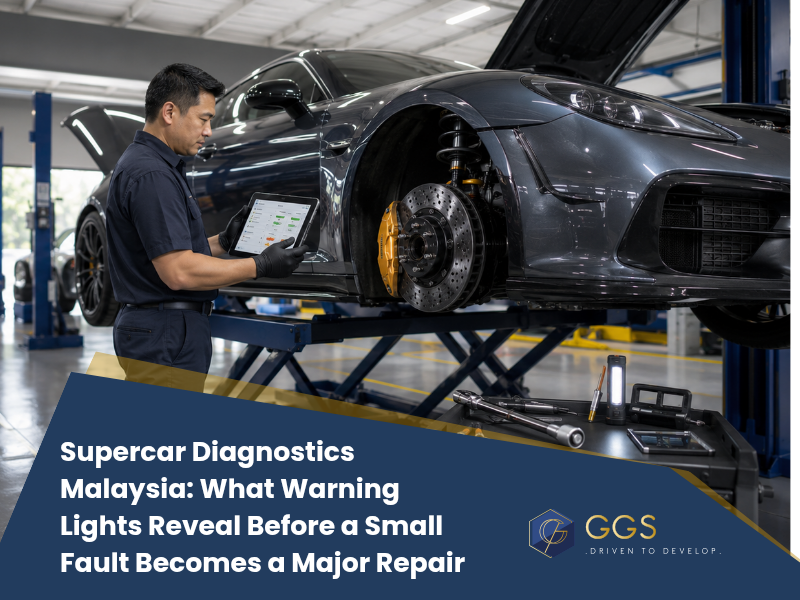
Table of Contents
Introduction
A warning light in a supercar is rarely just a simple dashboard notification.
Modern supercars depend on a network of control modules that constantly monitor oil pressure, fuel delivery, ignition timing, cooling performance, transmission temperature, boost pressure, suspension position, braking behaviour and battery voltage. When one system operates outside its expected range, the car may display a warning before the driver notices any obvious change.
That early warning matters.
A supercar may still feel fast, smooth and responsive while a fault is developing in the background. The danger is not always the original problem. It is the secondary damage that can follow when the vehicle continues to be driven under load.
Professional supercar diagnostics in Malaysia should therefore answer three questions:
- What triggered the warning?
- Is the fault still active?
- What could be damaged if the car continues to be driven?
Why Supercar Warning Lights Are Different
Many premium vehicles use advanced electronics, but supercars usually operate closer to their mechanical and thermal limits.
Their engines may run with high compression, forced induction, specialised cooling systems or dry-sump lubrication. Their transmissions may use dual-clutch systems that depend on precise temperature, pressure and clutch adaptation data. Active suspension, adaptive aerodynamics and electronic differential systems may also communicate with the engine and stability-control modules.
This creates a diagnostic challenge: one fault can trigger warnings in several apparently unrelated systems.
For example, a weak battery may cause engine, suspension and transmission warnings at the same time. A wheel-speed sensor fault may affect ABS, traction control, launch control and active suspension. A misfire may begin as an ignition problem but later damage the catalytic converter.
A generic scan may reveal the fault codes. It may not explain the chain of events that produced them.
Red, Amber and Flashing Warnings Do Not Mean the Same Thing
The colour and behaviour of a warning light can help indicate urgency.
Red warnings
A red warning usually requires immediate attention. Oil-pressure, overheating and serious brake-system warnings should not be treated as reminders to inspect the car later.
Continuing to drive may turn a repairable problem into engine, transmission or braking-system damage.
Amber or yellow warnings
An amber warning normally indicates that a fault has been detected but the vehicle may still be able to operate. This does not mean the issue is harmless.
An amber check-engine light may indicate a sensor fault, fuel-mixture problem, boost leak, emissions issue or intermittent misfire. The vehicle should be diagnosed before it is driven hard.
Flashing warnings
A flashing check-engine light is more urgent than a steady one. It often indicates an active misfire severe enough to send unburned fuel into the exhaust system.
On a high-performance vehicle, catalytic converters can become extremely hot. Continued driving may damage the catalyst, exhaust components or surrounding heat-sensitive parts.
Code Reading Is Not the Same as Diagnosis
This distinction is one of the most important things for supercar owners to understand.
A fault code does not always identify the failed part. It normally identifies the system, circuit or operating condition that the car has detected.
Suppose a scan shows a boost-pressure fault. The actual cause could be:
- a split hose;
- a loose clamp;
- an incorrect sensor reading;
- a sticking wastegate;
- damaged wiring;
- an air leak;
- a turbocharger-control problem.
Replacing the boost sensor without testing the rest of the system may not solve anything.
The same applies to oxygen-sensor codes, misfire codes, transmission-pressure faults and cooling-system warnings. A proper diagnosis should confirm the root cause before parts are ordered.
A Proper Supercar Diagnostic Process
A thorough diagnostic process should follow a sequence rather than jumping from a code directly to a repair.
1. Record the driver’s symptoms
The technician should ask when the warning appeared, whether it was flashing and what the car was doing at the time.
Important details include:
- cold start or hot restart;
- hard acceleration;
- stop-start traffic;
- high-speed driving;
- heavy rain;
- long-term parking;
- recent battery replacement;
- recent tuning or modifications.
2. Inspect the vehicle before clearing anything
A visual and physical inspection may reveal coolant residue, loose connectors, damaged hoses, oil leaks, underbody impact or signs of heat exposure.
3. Test battery and charging voltage
Voltage instability can create misleading fault codes across multiple modules. Battery condition should be checked before assuming several systems have failed at once.
4. Scan all control modules
A full-module scan is more useful than checking the engine computer alone. Supercar faults often involve communication between the engine, gearbox, suspension, brake and body-control systems.
5. Review freeze-frame and live data
Freeze-frame data shows what the vehicle was doing when the fault was recorded. Live data allows technicians to compare sensor readings while the engine is running or during a controlled test.
6. Perform targeted testing
Depending on the fault, this may include pressure testing, electrical continuity checks, smoke testing, cooling-system testing, ignition analysis or transmission adaptation review.
7. Verify the repair
After repairs, the system may need code clearing, adaptation, calibration or a road test. A repair is not complete until the original fault no longer returns under similar operating conditions.
Common Fault Progressions That Become Expensive
Supercar repairs often become costly because the first warning was ignored.
Misfire to catalytic-converter damage
A weak ignition coil or worn spark plug can cause an occasional misfire. If the car continues to be driven, unburned fuel may overheat and damage the catalytic converter.
Coolant leak to engine overheating
A small coolant leak may first produce a low-level warning or occasional temperature fluctuation. Continued coolant loss may lead to overheating, damaged seals or cylinder-head problems.
Oil-pressure fault to internal engine damage
A genuine oil-pressure warning can indicate insufficient lubrication. Continuing to drive may damage bearings, camshafts, turbochargers or other internal components.
Boost-control fault to turbocharger stress
A leaking hose or control issue can cause the system to work harder to achieve the requested boost level. Over time, this may increase stress on the turbocharger and related components.
Wheel-speed fault to disabled driver aids
A faulty wheel-speed signal may disable ABS, traction control, stability control or launch-related systems. The car may still move normally, but several safety and performance systems may no longer function correctly.
Warning Lights That Appear Only During Hard Acceleration
Some supercar faults do not appear during gentle driving.
A warning that appears only under heavy throttle may point to:
- ignition breakdown under load;
- fuel-pressure drop;
- boost leak;
- overboost or underboost;
- intake-airflow error;
- transmission-temperature rise;
- clutch-slip detection;
- knock-control intervention.
This is why a car can appear normal during a short workshop idle test yet produce a warning when driven aggressively.
A specialist technician may need to compare live data under controlled load while avoiding unnecessary risk to the engine and drivetrain.
How Malaysia’s Climate Can Affect Supercar Diagnostics
Malaysia’s heat, humidity and traffic conditions can influence how faults appear.
High ambient temperatures place additional demand on cooling systems, air-conditioning systems and batteries. Stop-start traffic in Petaling Jaya and the Klang Valley can also reduce airflow while engine-bay temperatures continue to rise.
Supercars that are driven only on weekends may face a different problem. Long periods of inactivity can weaken the battery, allow seals to dry, reduce tyre pressure or create intermittent electrical issues.
Humidity and water exposure may also affect connectors, grounds and wiring, particularly after heavy rain, washing or long-term storage.
This makes local operating conditions an important part of the diagnostic discussion, not just the fault code itself.
Supercar Systems That Need Specialist Interpretation
A warning light may involve systems not commonly found in ordinary vehicles.
These can include:
- dry-sump oil-pressure monitoring;
- active exhaust valves;
- adaptive aerodynamic components;
- electronic limited-slip differentials;
- carbon-ceramic brake wear monitoring;
- active engine mounts;
- adaptive dampers;
- ride-height sensors;
- dual-clutch adaptation values;
- launch-control protection logic;
- turbocharger heat-management systems.
A workshop should understand how these systems interact rather than treating each warning as an isolated fault.
When Should the Car Be Stopped Immediately?
Stop driving and arrange professional assistance when the vehicle shows:
- a red oil-pressure warning;
- severe overheating;
- a flashing check-engine light;
- a major brake-system warning;
- heavy smoke;
- strong fuel or burning smells;
- sudden power loss;
- severe gearbox malfunction;
- abnormal knocking or grinding.
A steady amber warning may allow the car to be moved carefully, but hard acceleration, high engine speeds and long-distance driving should be avoided until the cause is known.
When in doubt, protecting the engine, transmission and braking systems is more important than completing the journey.
Choosing a Supercar Diagnostics Workshop in Petaling Jaya
A suitable workshop should be able to explain the difference between the fault code and the confirmed cause.
Owners should expect clear answers to questions such as:
- Which module recorded the fault?
- Was the fault active, stored or intermittent?
- What operating conditions triggered it?
- What tests confirmed the failed component?
- Could another system be contributing to the warning?
- What happens if the repair is delayed?
For supercar owners seeking an automotive workshop in Petaling Jaya, facility capability also matters. GGS Premium Car Service Center operates from a 33,000 sq ft facility with 34 working bays, a dedicated inspection bay, body and paint repair bays, and multiple two-post and scissor hoists.
These facilities allow electronic diagnosis to be supported by physical inspection, underbody checks, leak detection and mechanical testing when required.
Frequently Asked Questions
1. Why do several warning lights appear at the same time?
Several systems may depend on the same sensor, voltage supply or communication network. One battery, wiring or wheel-speed fault can therefore trigger multiple warnings.
2. Can a weak battery cause transmission and suspension warnings?
Yes. Low voltage can interrupt communication between control modules and create faults in systems that are not mechanically damaged.
3. What is limp mode?
Limp mode is a protective operating strategy that limits power, engine speed, boost or transmission behaviour to reduce the risk of further damage.
4. Can aftermarket tuning trigger warning lights?
Yes. Engine tuning, exhaust changes, intake modifications or altered boost settings may cause readings outside the manufacturer’s expected range.
5. Why does the warning appear only during hard acceleration?
The fault may occur only when fuel demand, boost pressure, ignition load or transmission temperature rises.
6. Can different tyre sizes trigger warning lights?
Yes. Incorrect tyre sizes or uneven rolling diameters can affect wheel-speed readings, stability control, ABS and all-wheel-drive systems.
7. Can heavy rain or washing cause warning lights?
Water entering a connector or damaged wiring area can cause temporary or persistent electrical faults, especially in low-mounted sensors.
8. Should fault codes be cleared before diagnosis?
No. Clearing codes may erase freeze-frame data and other evidence showing when the fault occurred.
9. Does a supercar need dealer-only diagnostic equipment?
Not always. A specialist independent workshop can diagnose many faults if it has suitable brand-compatible equipment, technical information and experienced technicians.
10. What information should I give the workshop?
Provide a photo of the warning, the driving conditions when it appeared, whether it flashed, any unusual sound or smell, and details of recent repairs, battery changes or modifications.
Final Thoughts
A supercar warning light should be treated as an early technical message, not merely an illuminated symbol.
The most expensive repairs often happen when a small misfire, coolant leak, voltage issue or pressure fault is allowed to continue until it damages another component.
Professional supercar diagnostics in Malaysia should combine full-module scanning, live-data analysis, electrical testing, mechanical inspection and brand-specific knowledge. For owners in Petaling Jaya and the Klang Valley, early diagnosis offers the best chance to correct the original fault before it develops into a larger engine, transmission, braking or electronic repair.