Expert Articles for Smarter Car Care
Toyota Alphard, Vellfire and Land Cruiser Service in Petaling Jaya: The Checks Routine Servicing May Miss
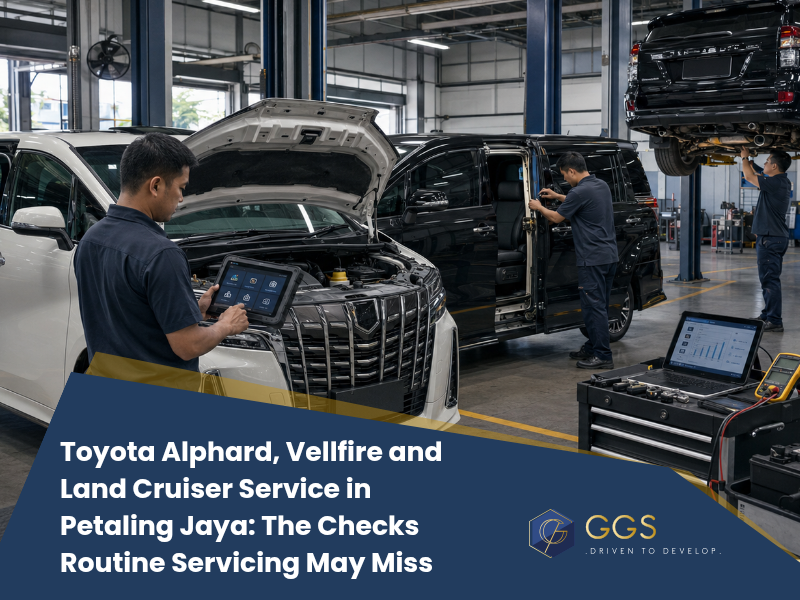
Table of Contents
An Alphard can still feel smooth while its sliding-door rollers, rear suspension bushings or hybrid battery cooling system are beginning to deteriorate. A Vellfire may show several warning lights even though the real issue is only a weak 12-volt battery. A Land Cruiser can continue driving confidently while its transfer case, differential oil or underbody components receive little attention.
That is why servicing these Toyota models should involve more than an engine oil change and a brief visual inspection.
Although the Alphard, Vellfire and Land Cruiser are known for durability, they are built for very different purposes. The Alphard and Vellfire prioritise passenger comfort, quiet operation and cabin electronics. The Land Cruiser is designed for heavy loads, long-distance travel and demanding road conditions.
A specialist workshop in Petaling Jaya should understand those differences and inspect each vehicle according to its design, mileage, service history and actual usage.
The First Step Is Understanding How the Vehicle Is Used
A useful inspection begins before the vehicle is lifted or connected to a diagnostic scanner.
An Alphard used for daily school runs may experience repeated short journeys, long periods of idling and frequent power-door operation. A chauffeur-driven Vellfire may spend hours in Petaling Jaya traffic with the air-conditioning running while the vehicle is stationary. These conditions place additional strain on the cooling system, battery, suspension and cabin electronics.
A Land Cruiser used mainly for highway travel requires a different maintenance approach from one regularly driven on construction sites, plantation roads or uneven terrain. Towing, heavy cargo and off-road use can also accelerate wear in the drivetrain, suspension and underbody.
The service adviser should therefore ask when the symptoms occur, how the vehicle is normally driven and whether previous repairs have solved the original complaint.
A Proper Inspection Should Come Before Parts Replacement
Owners sometimes arrive at a workshop after being told that a motor, sensor or control module must be replaced. However, the part showing the symptom is not always the source of the problem.
A slow Alphard sliding door may have a healthy motor but worn rollers that create excessive resistance. A Vellfire transmission complaint may actually come from deteriorated engine mountings. A humming sound in a Land Cruiser may originate from a tyre or wheel bearing rather than the differential.
A pre-repair inspection should confirm the complaint, review the service history, inspect visible wear and reproduce the symptom where possible. This reduces the risk of replacing expensive components based only on an assumption.
Full-System Diagnostics Matter More Than Reading One Fault Code
Modern Toyota vehicles use multiple electronic control units. A basic scanner may read the engine system but miss faults stored in the transmission, braking, body-control, hybrid or four-wheel-drive modules.
The value of a diagnostic scan is not simply retrieving a code. The technician must examine live data, voltage behaviour, freeze-frame information and the relationship between different systems.
For example, several unrelated warnings may appear when battery voltage drops below the expected level. Replacing individual sensors without testing the battery and charging system may waste time and money.
Similarly, clearing a fault code without identifying why it appeared can temporarily hide the warning while leaving the underlying problem unresolved.
Alphard and Vellfire: Comfort Systems Deserve Mechanical Attention
The Alphard and Vellfire are often treated as ordinary MPVs during servicing, but many ownership complaints are linked to systems outside the engine.
Their weight, passenger load and comfort-focused suspension make worn bushings, weak shock absorbers and damaged stabiliser links especially noticeable. The vehicle may still drive normally with one person inside but feel unstable, noisy or low at the rear when fully occupied.
Power sliding doors also require more than an electrical test. The workshop should inspect the rollers, cables, tracks, alignment, sensors and anti-pinch function. Replacing the motor alone may not solve a door that is physically binding.
Rear air-conditioning performance should also be checked independently from the front system. Weak airflow, uneven temperature or blower noise may point to filter blockage, motor wear or problems within the rear climate-control system.
Hybrid Alphard and Vellfire Models Need Specific Testing
Hybrid variants require technicians who understand both high-voltage safety and Toyota hybrid data.
A proper assessment may include battery state of health, cell-voltage differences, battery temperature and cooling-fan performance. The technician should also inspect the battery ventilation path, as dust or debris can restrict airflow and increase operating temperature.
A hybrid warning does not automatically mean the traction battery requires replacement. The issue may involve the cooling system, inverter, wiring, temperature sensor or a supporting electrical component.
This is why testing should come before any major recommendation.
Engine Oil, Mountings and Cooling Systems
Routine oil servicing remains essential, but the correct specification matters as much as the interval.
Vehicles that spend long periods idling in Malaysian heat may accumulate operating hours faster than their mileage suggests. Oil condition, filter quality, leakage and consumption should therefore be considered together rather than judged by distance alone.
Engine mountings also deserve attention. Worn mountings can cause vibration when idling, shifting into gear or accelerating. These symptoms may be mistaken for a transmission problem if the vehicle is not inspected carefully.
Cooling-system inspection should cover the radiator, hoses, water pump, thermostat, fans and coolant condition. In Petaling Jaya traffic, a cooling system may appear normal at highway speed but struggle during extended idling because airflow depends heavily on the fans.
Land Cruiser: Drivetrain Inspection Should Go Beyond the Gearbox
The Land Cruiser requires a more detailed drivetrain inspection than a typical urban vehicle.
In addition to the automatic transmission, the workshop should assess the transfer case, front and rear differentials, propeller shafts, universal joints and four-wheel-drive actuators.
Fluid leakage around a differential or transfer case may appear minor, but prolonged low fluid levels can damage internal components. Clunking during acceleration may come from drivetrain play, while vibration at a particular road speed may be related to the propeller shaft, tyres or wheel balance.
The workshop should isolate the source before recommending expensive repairs.
Four-wheel-drive functions should also be tested periodically. A system that is rarely used may develop actuator or engagement problems without affecting normal two-wheel or full-time road driving.
Underbody Checks Are Important After Rough-Road Use
Land Cruisers are often assumed to be unaffected by rough conditions because of their strength. However, durability does not eliminate wear.
After off-road use, deep water exposure or travel on uneven surfaces, the workshop should inspect skid plates, suspension arms, steering joints, differential housings, driveshafts and exhaust components.
Mud trapped around mechanical parts can hide leaks or retain moisture. Impact damage may also affect alignment or protective covers even when the vehicle continues to drive normally.
Suspension, Steering and Brakes Affect More Than Comfort
Suspension wear often develops gradually, so owners may adapt to the change without noticing it.
On Alphard and Vellfire models, worn components may cause rear sagging, knocking sounds, excessive body movement or uneven tyre wear. On the Land Cruiser, steering play, shock-absorber wear and wheel-bearing problems may affect stability and braking confidence.
Brake noise should also be interpreted carefully. A light squeal may come from pad material or surface contamination, while grinding usually indicates more severe wear. Vibration during braking may relate to disc condition, suspension movement or wheel-related issues.
Battery Condition Can Affect Multiple Systems
The 12-volt battery supports many of the vehicle’s control systems, even in hybrid models.
A weak battery may cause intermittent door operation, warning lights, unstable starting or communication faults between modules. Because the symptoms can appear unrelated, owners may suspect several separate failures.
A specialist workshop should test battery health, charging voltage and electrical connections before recommending electronic components.
Final Road Testing Is Part of the Repair
A vehicle should not be considered ready simply because the warning light has disappeared.
The final road test should confirm that the original symptom is no longer present and that steering, braking, shifting and suspension behaviour are normal. On an Alphard or Vellfire, this may include checking cabin vibration and door operation. On a Land Cruiser, it may include listening for drivetrain noise and confirming stability at different speeds.
The workshop should also perform a final scan where appropriate to confirm that no fault has returned.
What Owners Should Expect from a Specialist Workshop in Petaling Jaya
A credible workshop should explain what was found, why it matters and which repairs are urgent.
Owners should be shown the difference between a confirmed fault, an early sign of wear and a preventive recommendation. They should also receive suitable parts options, a clear estimate and an explanation of how the repair will be verified.
Larger MPVs and four-wheel-drive vehicles also require suitable lifting equipment, underbody access and sufficient working space. GGS Premium Car Service Center operates from a 33,000 sq ft facility in Petaling Jaya with 34 working bays, including inspection, body and paint, and hoist-equipped service areas.
Frequently Asked Questions
1. Can an imported Alphard or Vellfire be serviced in Malaysia?
Yes, but the workshop should identify the exact model, engine, drivetrain and market specification before ordering parts or applying service information.
2. Should the vehicle be scanned even when no warning light is showing?
A scan can still reveal pending, historical or intermittent faults. It is especially useful when the owner reports occasional electronic or performance symptoms.
3. Does a slow power sliding door always need a new motor?
No. Worn rollers, damaged cables, dirty tracks, poor alignment or weak voltage may create the same symptom.
4. Is transmission flushing always recommended?
No. The correct approach depends on the transmission type, fluid condition, mileage, symptoms and service history. Inspection should come before the decision.
5. How can a workshop tell whether vibration comes from the engine or transmission?
The technician may compare vibration in different gears, inspect engine mountings, review live data and perform a controlled road test.
6. Should a Land Cruiser be inspected after off-road use?
Yes, especially after impact, mud, deep water or rough terrain. Underbody, drivetrain, steering and suspension components should be checked.
7. Can suspension wear cause uneven tyre wear?
Yes. Worn bushings, ball joints, shock absorbers or steering components can affect wheel position and tyre contact.
8. Why do several warning lights sometimes appear at once?
Low battery voltage, charging problems or communication faults can trigger multiple warnings. A full-system diagnosis is needed before replacing parts.
9. What records should owners bring to the workshop?
Service records, previous repair invoices and details of when the symptom occurs can help technicians avoid repeating tests and identify recurring problems.
10. How should owners choose a Toyota specialist workshop in Petaling Jaya?
Look for model-compatible diagnostic equipment, experienced technicians, transparent findings, suitable lifting facilities and a repair process that includes verification and road testing.
Conclusion
The Alphard, Vellfire and Land Cruiser are all durable Toyota models, but their maintenance priorities are not the same.
The Alphard and Vellfire require close attention to comfort systems, hybrid components, suspension, power doors and cabin electronics. The Land Cruiser needs more detailed drivetrain, underbody and four-wheel-drive inspection.
A specialist workshop should do more than follow a routine service checklist. It should understand how the vehicle is used, confirm the actual cause of the complaint and explain the findings clearly. That is what helps owners avoid unnecessary replacement, identify wear earlier and preserve the vehicle’s comfort, reliability and long-term value.