Expert Articles for Smarter Car Care
Luxury Car Battery Keeps Going Flat: How a Workshop Diagnoses Parasitic Electrical Drain
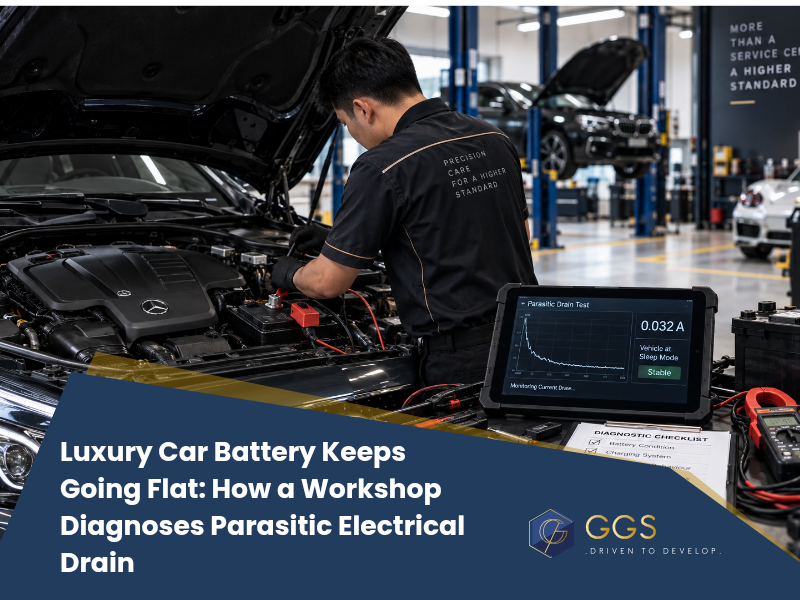
Table of Contents
A luxury car battery that repeatedly goes flat can be frustrating, especially when the battery has already been replaced. In many cases, however, the battery itself is only showing the symptom. The actual problem may be an abnormal electrical load that continues drawing power after the vehicle has been switched off.
Modern luxury and continental vehicles contain numerous control modules, sensors, communication networks, security systems and comfort features. Some electrical activity after shutdown is normal. The challenge for a workshop is determining whether the vehicle eventually enters its intended sleep state or whether something continues consuming excessive current.
For this reason, professional diagnosis should follow a structured process: verify the battery, check the charging system, measure key-off current, observe sleep behaviour, isolate the affected circuit and confirm the root cause before replacing components.
A Flat Battery Does Not Automatically Mean a Bad Battery
When a vehicle arrives with a no-start complaint, replacing the battery immediately may appear to be the fastest solution. But a discharged battery and a defective battery are not the same thing.
A battery may repeatedly lose charge because of:
- poor battery condition;
- inadequate charging;
- excessive key-off current draw;
- a control module remaining awake;
- an incorrectly installed electrical accessory;
- wiring or relay faults;
- alternator leakage.
The first task for the workshop is therefore to establish whether the battery can still accept and retain charge. State of charge, battery health, capacity, terminal condition and ground connections may all need to be checked before investigating more complicated electrical faults.
This prevents a common problem: installing a new battery only for the customer to return several days later with the same complaint.
The Charging System Must Be Checked First
Before calling the problem a parasitic drain, the workshop should confirm that the vehicle is actually replenishing the battery while it is being driven.
Charging-system diagnosis may involve checking charging voltage, current output, battery-management data, wiring and ground integrity. Modern vehicles can also vary charging behaviour according to electrical demand, battery condition and energy-management strategy, so a simple voltage reading does not always tell the whole story.
A charging fault and a parasitic drain can produce similar symptoms, but their causes are very different.
A weak charging system means the battery is not receiving enough energy.
A parasitic drain means excessive electrical energy is being consumed after the vehicle is parked.
What Is Parasitic Electrical Drain?
Parasitic electrical drain refers to electrical current being consumed while the vehicle is switched off beyond what is considered normal for that vehicle.
Other related terms include:
- parasitic current draw;
- key-off current;
- standby current;
- quiescent current;
- closed-circuit current.
Some current consumption is expected. Security systems, memory functions, telematics and other electronic systems may require a small amount of power even when the vehicle is parked.
The important question is not whether current exists, but whether the current eventually falls to an expected level after the vehicle completes its shutdown sequence.
Why Sleep Mode Matters on Modern Luxury Cars
A modern vehicle does not become electrically inactive the moment the ignition is switched off.
Control modules may continue communicating, saving information or completing shutdown routines. After a period of time, many of these modules should enter a low-power sleep state.
A professional parasitic-drain test therefore involves more than measuring current immediately after switching off the engine.
The workshop may need to observe:
ignition off → modules remain active → network activity reduces → modules enter sleep mode → current draw stabilises
If current remains unusually high after the expected shutdown period, the next question is why.
In some cases, the problem is not simply a component consuming too much electricity. A faulty component may be repeatedly waking other modules, preventing the entire communication network from settling.
When a Control Module Refuses to Sleep
Luxury cars can contain numerous electronic modules controlling functions such as:
- infotainment;
- telematics;
- central locking;
- keyless entry;
- alarm systems;
- seats;
- lighting;
- doors and tailgates;
- climate functions;
- body electronics.
One module remaining active can potentially keep several other modules communicating.
The diagnostic relationship may look like this:
faulty component → wake-up signal → network stays active → multiple modules remain awake → battery continues discharging
This is why replacing whichever module appears to consume electricity first may not solve the problem. The technician needs to determine what is keeping that system awake.
Aftermarket Accessories Are Important Diagnostic Clues
One of the first questions during workshop intake should be whether any electrical accessory has been added or modified.
Examples include:
- dash cameras;
- GPS trackers;
- alarm systems;
- audio amplifiers;
- aftermarket head units;
- ambient lighting;
- chargers;
- OBD-connected devices.
An accessory connected incorrectly to a permanent power supply may continue operating after the car is parked.
More complicated problems can occur when an accessory interacts with the vehicle’s communication system and prevents normal network shutdown.
The workshop therefore needs to consider not only how much current an accessory consumes, but also whether its installation changes how the vehicle goes to sleep.
Wiring, Connectors and Previous Repairs Can Also Cause Drain
Not every electrical drain is caused by a sophisticated electronic control module.
Damaged wiring, corrosion, water ingress, poorly repaired connectors, incorrect splices or a relay remaining energised can also create unwanted current paths.
Previous accident repairs and electrical modifications deserve particular attention because wiring may have been rerouted, repaired or connected incorrectly.
A structured electrical diagnosis should therefore combine electronic scanning with physical inspection when the evidence points toward a particular circuit.
Can the Alternator Drain a Battery While Parked?
Yes. The alternator should not only be considered when checking whether the battery is charging.
The alternator contains rectifier diodes that control the direction of electrical current. If a diode develops a fault, current may leak through the alternator circuit while the engine is switched off.
This creates an important distinction:
Charging-system failure: the battery is not being replenished correctly while driving.
Alternator leakage: the battery may charge while driving but lose power through the alternator circuit when parked.
This is why a workshop should test the charging system as part of the broader electrical diagnosis rather than assuming that normal charging voltage automatically clears the alternator of suspicion.
How a Workshop Measures Parasitic Current Draw
Once battery and charging condition have been checked, the workshop can determine whether abnormal key-off current exists.
Depending on the diagnostic method, technicians may use an ammeter, suitable current-measuring equipment or a current clamp to observe electrical consumption.
The important factor is not simply one number.
Current should be considered over time.
A technician may monitor:
- initial shutdown current;
- how long modules remain active;
- when the current falls;
- whether it stays stable;
- whether unexpected spikes occur later.
This is particularly important with intermittent drains that may not appear during a short inspection.
How Technicians Isolate the Problem Circuit
If excessive current is confirmed, the next step is to identify which circuit is responsible.
Depending on the vehicle and fault, technicians may use:
- circuit-current measurement;
- fuse voltage-drop testing;
- relay testing;
- selective circuit isolation;
- connector checks;
- scan data.
Once a suspicious circuit is identified, the workshop can determine which modules or components are connected to it.
The investigation then becomes progressively narrower:
abnormal current → affected circuit → connected component → confirm current change → identify root cause
This is more reliable than replacing components based on guesswork.
Why Diagnostic Scanning Still Matters
A scan tool may not directly announce, “This component is draining the battery.”
However, diagnostic information can provide useful evidence.
Stored information may include:
- undervoltage faults;
- module communication faults;
- energy-management events;
- unexpected wake-up activity;
- control-module errors;
- low-voltage history.
When combined with current measurements, wiring checks and vehicle behaviour, this information helps the technician understand what happened before the battery became discharged.
Intermittent Battery Drain Can Take Longer to Find
Some of the most difficult electrical faults are intermittent.
The vehicle may behave normally while it is in the workshop, yet the battery goes flat after being parked overnight or for several days.
Possible reasons include:
- a module waking periodically;
- a faulty door or boot switch;
- intermittent network communication;
- temperature-sensitive electrical faults;
- telematics activity;
- wiring movement;
- accessories operating only under particular conditions.
In these cases, longer-term current monitoring may be more useful than a short test.
The goal is to capture the electrical behaviour at the moment the abnormal drain occurs.
Diagnosis Before Parts Replacement Protects Both Customer and Workshop
Electrical problems can become expensive when diagnosis is replaced by trial-and-error parts replacement.
A new battery will not fix a module that stays awake. A replacement control unit will not fix incorrectly wired accessories. And replacing an alternator will not solve a drain originating from another circuit.
For the workshop, evidence-based diagnosis reduces:
- unnecessary parts replacement;
- repeat repairs;
- warranty disputes;
- customer dissatisfaction;
- wasted technician time.
It also provides a clearer explanation to the customer because the recommended repair can be supported by measurements and diagnostic evidence.
The Repair Is Not Complete Until the Result Is Verified
After repairing the identified fault, the workshop should repeat the diagnostic process.
This may include:
- correctly charging the battery;
- confirming battery condition;
- checking charging performance;
- allowing the vehicle to complete its shutdown sequence;
- monitoring key-off current again;
- confirming that modules enter sleep mode correctly.
Post-repair testing helps establish that the original fault has actually been resolved rather than temporarily disappearing.
A good workshop record should document the customer’s complaint, initial battery condition, charging-system result, current-draw findings, affected circuit, identified cause, repair performed and final verification.
For complex luxury vehicles, this structured approach is often more valuable than simply changing the battery and hoping the problem does not return.
Frequently Asked Questions
1. Why does my luxury car battery keep going flat even after replacement?
A new battery can still discharge if there is an underlying charging problem or excessive electrical consumption while the vehicle is parked. The battery may be the victim rather than the cause.
2. What is parasitic battery drain?
Parasitic drain is excessive electrical current being consumed when the vehicle should be in a low-power state after shutdown.
3. Does every car use electricity when switched off?
Yes. Some standby consumption is normal because systems such as security, memory and certain electronic functions remain powered.
4. How does a workshop know whether the current draw is excessive?
Technicians monitor electrical consumption after the vehicle has been switched off and compare its behaviour with the expected shutdown and sleep strategy for that vehicle.
5. Why must the workshop wait before testing?
Modern control modules may remain active for some time after ignition-off. Testing too early can mistake normal shutdown activity for a fault.
6. Can a control module drain the battery?
Yes. A faulty module may stay awake or cause other modules on the vehicle network to remain active.
7. Can a dashcam or GPS tracker cause battery drain?
Yes. Aftermarket accessories may consume power continuously or interfere with normal vehicle shutdown if they are installed incorrectly.
8. Can the alternator cause a flat battery when the engine is off?
Yes. Certain internal alternator faults can allow reverse current leakage through the charging circuit while the vehicle is parked.
9. Why can parasitic drain be difficult to diagnose?
Some drains occur intermittently or only several hours after shutdown. The vehicle may therefore appear normal during a short workshop inspection.
10. Should the battery simply be replaced first?
Not necessarily. Battery condition should be tested, but repeated battery replacement without identifying why the battery discharged can lead to the same problem returning.