Expert Articles for Smarter Car Care
Audi Electrical System Problems: Battery, Wiring, Grounds, Sensors and Warning Lights
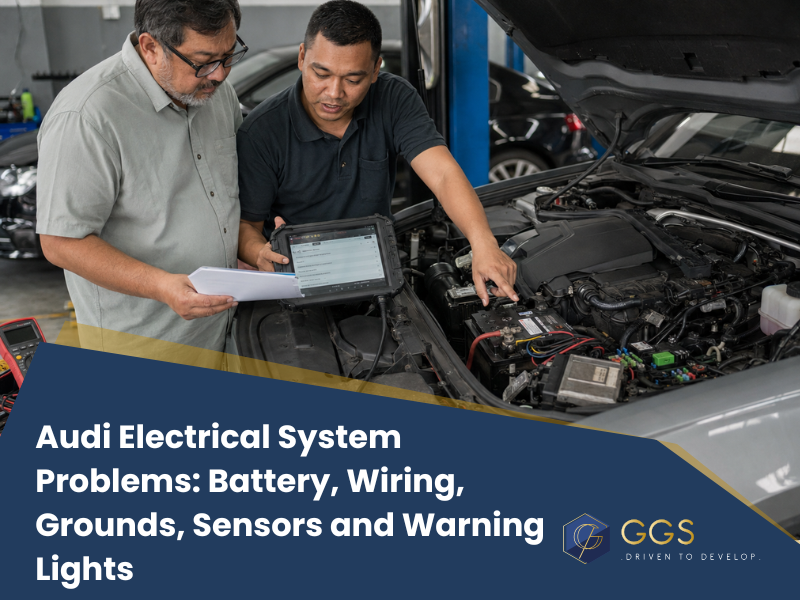
Table of Contents
Introduction
Audi vehicles are known for advanced electronics, refined comfort systems and precise engine control. However, this also means Audi electrical problems can sometimes feel confusing for owners. A single weak battery, poor ground connection, unstable alternator output or sensor circuit fault can trigger several warning lights at once.
For Audi owners, the key point is this: multiple warning lights do not always mean multiple parts have failed. In many cases, the real issue is a shared electrical problem affecting several systems at the same time.
Before replacing sensors, control modules or expensive parts, proper electrical diagnosis is important.
Why Audi Electrical Problems Can Be Hard to Diagnose
Modern Audi vehicles rely on many control modules and sensors. The engine control unit, transmission control unit, ABS module, stability control system, body control module, infotainment system and gateway module all communicate with each other.
This means one electrical fault can affect several systems. For example, unstable voltage may cause warning messages across the dashboard. A poor ground may affect sensor readings. A wiring fault may interrupt communication between modules. A sensor circuit problem may cause the car to enter limp mode.
This is why Audi owners may see warning lights such as check engine light, EPC warning, ABS warning, traction control warning, battery warning or electrical system malfunction messages together.
The problem is not always the part shown in the warning message. It may be the power supply, ground, wiring or communication network behind it.
Common Signs of Audi Electrical System Problems
Audi electrical faults can appear in many ways. Some are obvious, while others happen only sometimes.
Common signs include multiple dashboard warning lights, slow cranking, no-start issues, flickering lights, infotainment rebooting, weak battery symptoms, intermittent loss of power, limp mode, poor throttle response or random warning messages.
Some Audi owners may also notice that the fault appears after rain, after washing the car, during hot weather, after a battery replacement, or after recent repair work. These patterns matter because electrical faults are often affected by moisture, heat, vibration and connection quality.
If several systems behave strangely at once, it is better to think in terms of shared electrical causes instead of assuming every affected part is faulty.
Main Causes: Battery, Alternator, Grounds and Wiring
The battery is one of the first things to check. Audi vehicles can be sensitive to weak or unstable battery voltage. A battery may still start the car but still be weak enough to trigger warning messages or module communication issues.
The alternator should also be tested. Once the engine is running, the alternator supplies electrical power and charges the battery. If alternator output is weak or unstable, the vehicle may show charging warnings, dim lights, system resets or repeated battery problems.
Ground connections are another common cause of difficult electrical faults. A poor ground can affect modules, sensors, lights and starting behaviour. Because many systems depend on stable grounding, a single corroded or loose ground point can cause symptoms that appear unrelated.
Wiring and connectors also matter. Audi vehicles use complex wiring harnesses, and faults may occur due to heat, age, moisture, damaged insulation, corroded connectors, loose plugs, or previous repair work. A damaged wire may cause an open circuit, short circuit or intermittent signal loss.
Before replacing expensive modules, the basics should be checked first: battery health, alternator output, terminals, fuses, relays, ground points, connectors and wiring condition.
Sensor, 5V Reference and CAN-BUS Problems Explained
Many Audi sensors rely on stable voltage and signal circuits. Some sensors use a regulated 5V reference circuit supplied by the engine control module. This reference voltage allows sensors to send accurate information back to the vehicle.
The important thing is that several sensors may share the same 5V reference circuit. If one sensor shorts internally, or if one wire is damaged, it can pull down the shared circuit. When that happens, several sensor fault codes may appear at once.
For example, the scan tool may show faults related to throttle position, accelerator pedal position, pressure sensors or other engine sensors. This does not always mean every sensor is bad. The real issue may be a shorted sensor, damaged wiring, poor sensor ground, or a reference voltage fault.
Audi vehicles also rely heavily on CAN-BUS communication. CAN-BUS allows control modules to exchange information. If communication is interrupted, several systems may display warnings even though the root cause is a single wiring, module, voltage, or network issue.
This is why scan-tool diagnosis, wiring diagrams and circuit testing are important. Fault codes should be read as clues, not final answers.
What Audi Owners Should Do Before Replacing Parts
Before replacing parts, Audi owners should clearly record the symptoms. Note which warning lights appeared, whether the car started normally, whether the fault happened after rain, heat, bumps, battery replacement or recent repair work.
This information helps identify patterns. Intermittent Audi electrical faults are often easier to diagnose when the owner can explain when and how the problem appears.
When discussing the issue with a technician, ask whether the battery, charging system, grounds and wiring have been checked. If there are multiple sensor codes, ask whether the affected sensors share the same 5V reference, ground or control module circuit.
Avoid replacing multiple sensors based only on fault codes. Also, avoid repeatedly clearing codes without finding the cause. If the fault returns, the problem remains.
You should stop driving or arrange urgent inspection if the warning involves braking, steering, stability control, severe engine malfunction, charging failure, repeated stalling, limp mode or loss of power. Audi electrical faults can affect safety systems, not just convenience features.
FAQ
1. Why are multiple warning lights on in my Audi?
Multiple warning lights may appear because several systems share voltage supply, ground points, wiring or communication networks. A weak battery, poor ground, an alternator issue, or a CAN-BUS fault can trigger several warnings at once.
2. Does an Audi battery warning light always mean the battery is bad?
No. A battery warning light may also indicate alternator, charging circuit, belt, terminal or wiring issues. Both the battery and charging system should be tested.
3. Why does my Audi enter limp mode?
Limp mode usually means the vehicle has detected a fault that may affect engine, transmission or safety operation. Causes may include sensor faults, throttle issues, wiring problems, low voltage or control module communication faults.
4. What is an Audi ground fault?
A ground fault means the electrical return path is poor, loose, corroded or damaged. This can cause unstable sensor readings, random warning lights, starting issues and module communication problems.
5. What is a 5V reference circuit in an Audi?
A 5V reference circuit is a regulated voltage supply from a control module to certain sensors. If the circuit is shorted or pulled down, several sensor-related fault codes may appear together.
6. Can one bad sensor cause many Audi fault codes?
Yes. If several sensors share the same reference voltage or ground, a shorted sensor or a damaged wire can affect the entire circuit and trigger multiple fault codes.
7. What is CAN-BUS in an Audi?
CAN-BUS is the communication network that allows Audi control modules to share information. If the network is disrupted, the vehicle may show several warnings that seem unrelated.
8. Why does my Audi electrical fault appear only sometimes?
Intermittent faults may be caused by heat, moisture, vibration, loose connectors, corroded terminals or damaged wiring. These faults may appear and disappear depending on driving conditions.
9. Should I clear Audi fault codes first?
No. Fault codes should be diagnosed before clearing. Clearing codes may remove the warning temporarily, but it does not fix the cause.
10. When should I stop driving my Audi because of electrical warnings?
Stop driving if warnings involve braking, steering, stability control, charging failure, severe engine malfunction, limp mode, repeated stalling or sudden loss of power. These symptoms may affect safety and should be checked promptly.